• Profile
  • Press
  • Contact

Alexander Pincus

  • Profile
  • Press
  • Contact

Original Music Workshop To Open Venue In Old Williamsburg Sawdust Factory

Original-Music-Workshop-Huffington-Post.jpg

Via The Huffington Post,:

The non-profit group Original Music Workshop is gearing up to open a new music venue on Williamsburg's North 6th Street,already home to many of the neighborhood's favorite concert venues including Cameo, Public Assembly, and Music Hall of Williamsburg. 
But unlike its neighbors, Original Music Workshop seeks to be somewhat of a mecca for the "21st century artist" by providing ample rehearsal and recording space for both emerging and established musicians to collaborate and learn.
Part of the $15.6 million makeover will create a space for musicians and artists to create and present work, and for audiences to enjoy performances and shows.
The Workshop will be taking over a century old, historic sawdust factory in order to make room for the venue's reported 13,000 square-foot of space.
Original Music Workshop founder Kevin Dolan told the The Observer
It’s amazing you can knock down anything and build whatever you want. I’m hopeful that at least the south side of this block will still maintain its feel into the future. I don’t believe in fate, but the location, the architecture, everything about it was just ideal. Even in the doldrums of the market, that real estate wasn’t cheap.
The venue is expected to open in late 2013.
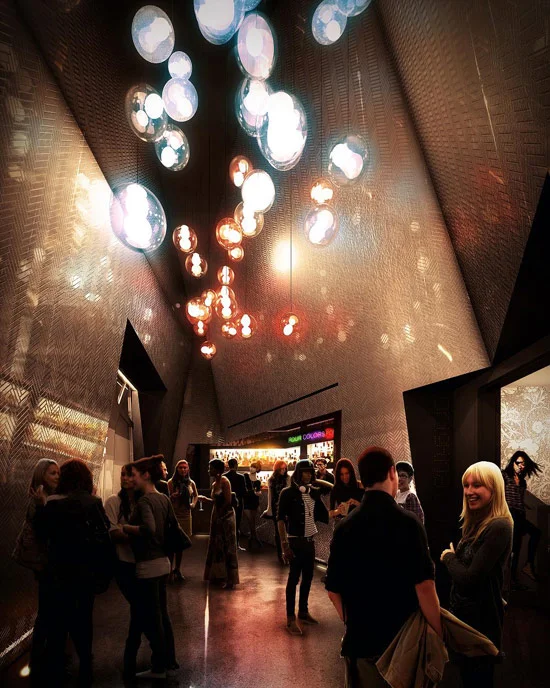
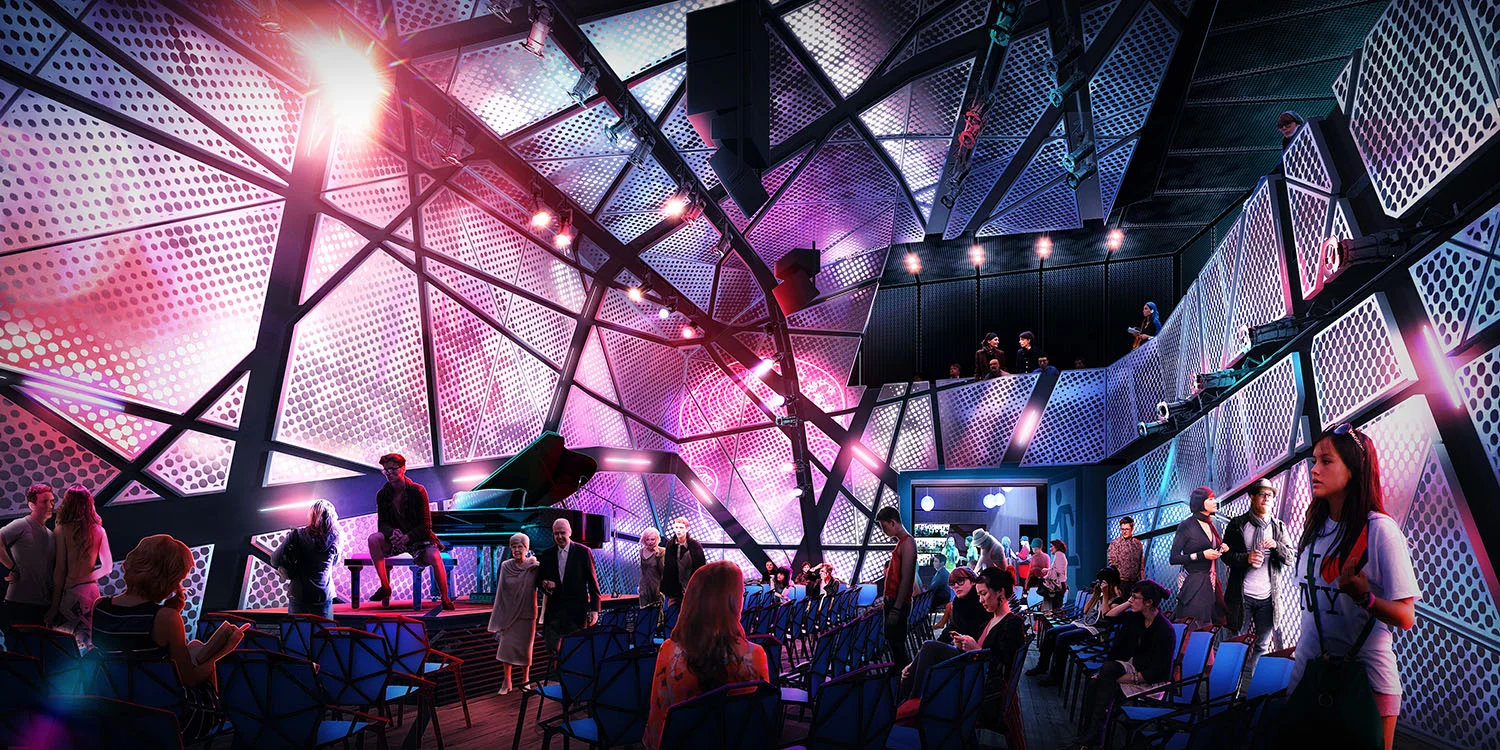
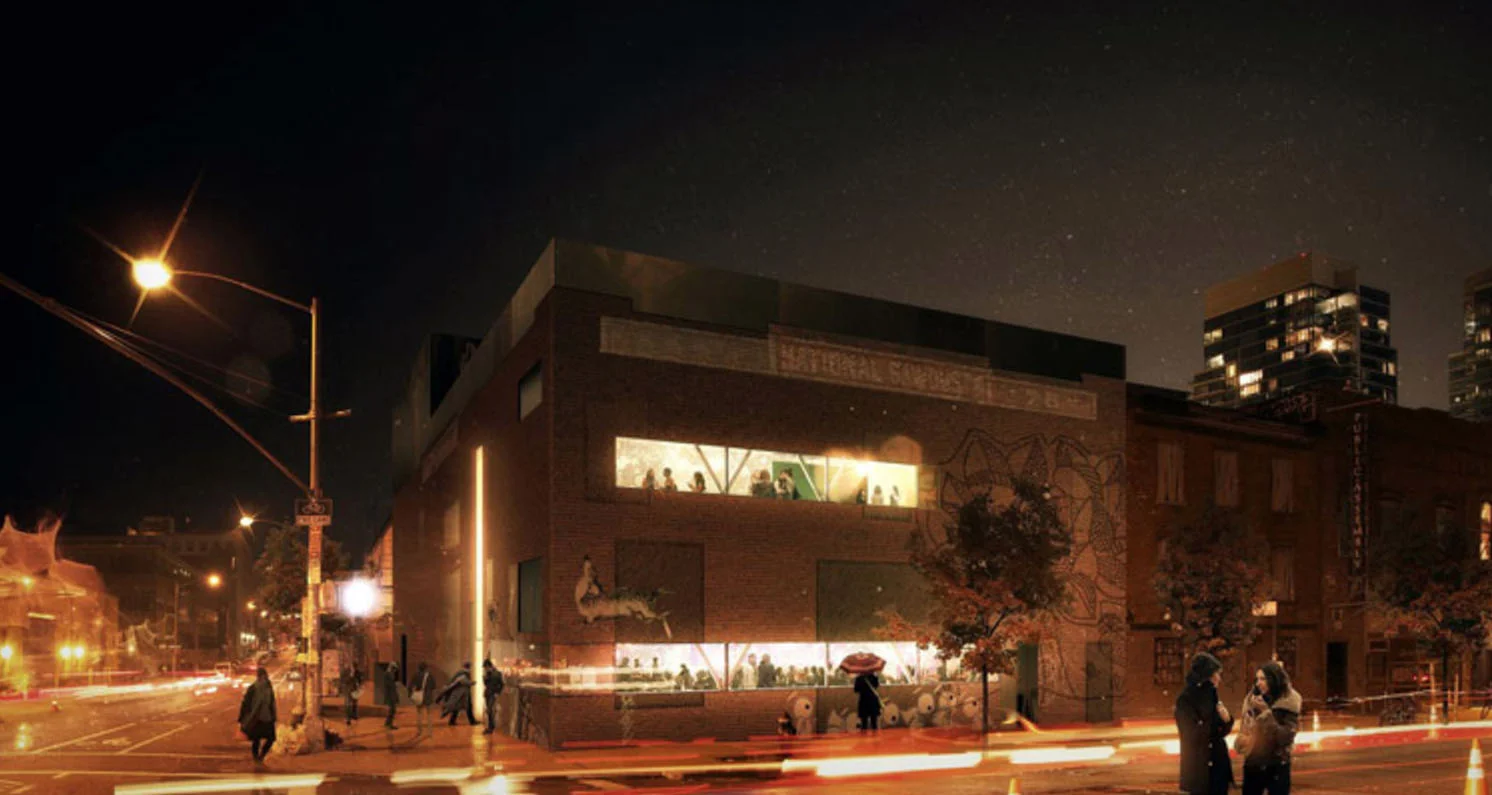
In conjunction with building a 21st century-minded space, renderings for the future venue reveal a unique, modern vision and an edgy interior design.
tags: Huffington Post
categories: Press, Archive
Tuesday 05.08.12
Posted by Alexander Pincus
 

Unveiled > An Acoustic Renewal in Brooklyn by Bureau V

Via The Architect’s Newspaper, written by Matt Shaw. 

Brooklyn-based architecture practice Bureau V unleashed a spectacular design for the Original Music Workshop, a new non-profit arts organization which will open in 2013 with a wide range of musical programming, from classical to jazz to experimental sound. Located in the heart of Williamsburg, Brooklyn, the performance center was designed in collaboration with engineering gurus Arup and features state of the art acoustical technologies.
Like any good construction in Brooklyn these days, the building is a high-tech, state-of-the-art renovation of a disused industrial building on Wythe and North 6th streets, just one block from the East River. In this case, it’s an acoustic performance center with a series of variable acoustic treatments that allow the space to be tuned to specific instrumentation using acoustically isolated box-in-box construction, which minimizes background noise to studio levels inside the graffitied, hollowed-out remains of a sawdust factory. The result is a sublime collision of new and old: technology and ruin, progress and history, refinement and grit.
Bureau V principal Peter Zuspan explained that OMW came to them with a “two-fold request: the space needed to be both acoustically superior and a comfortable and visually compelling space, a departure from the standard black box theater.” The acoustically-driven, geometrically complex chamber hall  will accomodate 170 chairs, or approximately 350 people standing. “The space is small enough to truly listen, while large enough to foster a sense of community,” said Bureau V principal Alexander Pincus. Because of its acoustical performance features, the space can double as a recording studio for up to 70 performers.
tags: The Architect's Newspaper
categories: Press, Archive
Tuesday 05.01.12
Posted by Alexander Pincus
 

Music Workshop Slated for Brooklyn

OMW in Wall Street Journal

OMW in Wall Street Journal

Via The Wall Street Journal, written by Pia Catton:

A new nonprofit that will nurture contemporary music is underway in Williamsburg. 
The Original Music Workshop (OMW) will be built within the shell of an existing warehouse at 80 North Sixth St., organizers will announce Tuesday.
The project, which has been developing for three years, is led by founder Kevin Dolan, a former senior vice president and general tax counsel at Merrill Lynch & Co. Mr. Dolan, an accomplished organist, described himself as "a fan of musicians" and an advocate for music.
Juilliard-trained composer Paola Prestini has been appointed creative director. 
Though OMW is scheduled for completion in late 2013, Ms. Prestini is lining up early, off-site performances, as well as artist residencies.
The inaugural residents will be new-music groups—the Knights, Brooklyn Rider, Talea Ensemble and ACME—as well as the multidisciplinary theater company Dangerous Ground Productions and the dance troupe Ballet Next. 
"The idea is to keep an open mind to the trends going on," said Ms. Prestini on the inclusion of groups outside the new-music realm.
The $15.6 million, 13,000-square-foot facility—designed by Bureau V, with acoustics by Arup—will allow for performances to be recorded and broadcast. When not in use for performances, the space will be available for rehearsal. Additionally, OMW will partner with Creative Capital to provide resources to mid-career artists.
"It's pretty much like a new music utopia," said Alex Lipowski of Talea. "They're saying, 'Here's a room that will sound great. Here's time and resources. And you can do whatever you what.'"
Corrections & Amplifications 
An earlier version of this article incorrectly identified Kevin Dolan a a faculty member at the New School for Jazz and Contemporary Music.
tags: The Wall Street Journal
categories: Press, Archive
Tuesday 04.24.12
Posted by Alexander Pincus
 

Is an Unconventional Music Venue with a Jagged Design the Last Hope for Williamsburg's Art Scene?

OMW in New York Observer

Via The New York Observer, written by Matt Chaban:

If Bedford Avenue is the main street of modern day Williamsburg, North Sixth Street is the hipster haven’s Broadway. Home to the first proper grocery store (Tops), concert venue (Northsix), swap meet (Artists and Fleas) and grotesque theme restaurant (Sea), North Sixth Street has long been the grand stage of Williamsburg.
Now performing on North Sixth Street (even if Northsix is long gone, replaced by a Manhattan concert conglomerate) is the Original Music Workshop.
Conceived by Kevin Dolan, a former tax attorney who also happens to be an organ virtuoso, the Original Music Workshop seeks to provide a venue bridging new and old Williamsburg, sustaining music of all types for all ages. As the rest of the neighborhood continues its inexorable gentrification, Mr. Dolan hopes to preserve a tiny corner of Williamsburg cultural past, as well as one of its historic industrial buildings.
“It’s amazing you can knock down anything and build whatever you want,” Mr. Dolan said in an interview. “I’m hopeful that at least the south side of this block will still maintain its feel into the future.”
The project began three years ago, in a small townhouse Mr. Dolan had hoped to turn into his perfect music space. He met local Williamsburg architecture firm Bureau V through a mutual acquaintance, and when they realized Mr. Dolan had far greater ambitions than his small site, they set about finding one. “A very interesting part of the project was that, after the house, we were, with the help of ARUP, very involved in the design of the entire concept,” said Alexander Pincus, one of the principals of Bureau V. “There was no programming, no building, no agenda for at least a year.” ARUP is the acoustical engineer on the project.
The designers set about scouring Brooklyn and parts of Manhattan until they found an old sawdust factory on the corner of North Sixth and Berry streets, a century-old sawdust factory—a painted sign near the roof still reads “NATIONAL SAWDUST,” which the facility produced at least until the 1940s, as old photos show. (For those confused by the concept of a sawdust factory, it was used for heating.)
“I don’t believe in fate, but the location, the architecture, everything about it was just ideal,” Mr. Dolan said. It was not an easy negotiation, though. “Even in the doldrums of the market, that real estate wasn’t cheap.” There were two other bidders for the property, which meant Mr. Dolan had to pay over ask, be he believes the seller ultimately chose him because of the project he planned there was more than another tear-down. “I think I got it on the merits of the use,” he said.
According to city records, Mr. Dolan paid $2.33 million for the former factory, and he said the entire project will cost about $15 million. The building had been vacant for a decade, but before that it had been producing those tiny colored pebbles that fill fish tanks, and was still full of them when the task of renovation began.
The former factory will continue to be a production facility of a sort. More than just a concert venue, Mr. Dolan is set on creating what he called an “A-to-Z support structure” for modern musicians. The space will also accommodate rehearsals and recordings, with room for up to 70 musicians during record sessions. For performances, a movable stage will accommodate between one and a dozen performers, with seating for 120 to 180 guests, up to 350 standing.
“It is a facility for which there is a tremendous need, it will be 24-hours a day, 7-days a week” said Paola Prestini, the celebrated young composer who was just named the creative director for the Original Music Workshop. Ms. Prestini said too often similar rehearsal and recording spaces were only open limited hours or had inferior acoustics. “What we’re trying to do with our project is serve the needs of the 21st Century artist,” she said.
The performers will cut across a wide artistic swath, from classical to jazz to electronica. The Observer suggested Le Poisson Rouge, the cutting-edge venue in Greenwich Village. Mr. Dolan responded that “that’s close, but we’re looking at one stratum down, the next big thing, though we will also be working with established artists from time to time.”
To that end, the Original Music Project is hoping to foster new talent through mentoring and residency programs, where artists can call the new space home for a series of time, working on new work or helping others form their own compositions.
This will all be achieved in a revolutionary space conceived by Bureau V. Mr. Dolan said he greatly preferred the old music halls of Europe. “I certainly do not want a black-box theater,” he said.
“Too often the space disappears, and Kevin did not want that, he wanted the space to be present, part of the performance” Peter Zuspan, another Bureau V principal, said. “With this, it’s kind of just a room—no fly space, no wings, no curtains, just a room. It’s a very classical idea.”
And yet the focus remains on new artists, new ideas, the cutting edge, which is certainly exposed in the design of the space. While the exterior of the building remains intact, inside is a mass of steel beams metal mesh, all with exacting perfomative standards. “This is not some historical pastiche,” Mr. Pincus said. “We’ve got 15-inch-thick brick walls, which you could never afford to build these days. The building is still very purposeful.”
Affixed to the brick interior is carefully crafted acoustic paneling, which is overlaid with the metal lattice. This not only supports the mesh but also contains all electrical, lighting, pass-throughs and all other elements required for performance and recording. The shape may look random, even haphazard, but it was all carefully tailored through hours upon hours of precise computer modelling, one of Bureau V’s specialties. (The firm is working on a similarly unusual residential development next door, which is still in the early planning stages.)
The bi-level space also includes a restaurant, still being developed. So the musicians and the crowd really do have everything. “We want to nurture artists who have not yet made it onto the other stages of New York,” Mr. Dolan said.
tags: The New York Observer
categories: Press, Archive
Tuesday 04.24.12
Posted by Alexander Pincus
 

Could startups crowdsource equity investments?

Alexander Pincus in Crain's Business

Via Crain's Business, written by Judith Messina:

The “crowd funding” craze hit the Internet with a splash a few years ago as a way of harnessing social media to raise money for causes or projects that strike an emotional chord with donors. In New York, sites such as Kickstarter and RocketHub provide a platform for the likes of inventors, independent filmmakers and young fashion designers to get their creations off the ground.
Donors get a nominal payback, such as an early version of a product or a mention in the credits of a film, in addition, of course, to the feel-good perk of helping someone pursue a dream. And the idea has caught fire with dozens of sites exploiting the trend in the U.S. and abroad. Three-year-old Kickstarter says that a million people have backed projects on its platform, donating some $84 million for 13,000 projects. 
Now, there's a move on to take crowd funding to the next level, using it to raise equity capital for young businesses. Several bills to amend the nation's security laws are in process in Washington, D.C., and the movement supporting them has drawn an unlikely mix of supporters, including Republicans, Democrats and entrepreneurs.
“I see [crowd funding] as a positive,” said Ian Fichtenbaum, a vice president with Near Earth, an investment banking firm that specializes in satellite technology, geo-spatial systems, aerospace and emerging telecommunications. “We see a lot of business plans from the edge of believability and the edge of technology, and some are actually good. When we raise capital for some of these companies, we have to find nontraditional sources or find people with a particular interest in the sector.”
In an environment where it's still very difficult for small businesses to get loans, the whole movement has taken on an almost missionary zeal. According to an advocacy website, Startup Exemption, “preventing entrepreneurs from soliciting financing from their fans and potential customer base equates to a massive form of economic suppression.”
A handful of sites that allow online investments already operate in Europe, but in the United States it's illegal for a business to solicit such investments from unaccredited investors—defined as investors with less than $1 million in assets—who are not friends or family. 
Last October, the House of Representatives passed a bill that would allow entrepreneurs to make general soliciations to raise up to $1 million (or $2 million if they provide audited financial statements) from unaccredited investors, each of whom could pony up a maximum of $10,000 or 10% of their annual income, whichever is less. Twenty-seven of New York's 28-member delegation voted for it. Two U.S. Senate bills would limit the amount raised to $1 million; one would limit the individual investment to $500, and the other would limit it to $1,000. Both bills focus on protecting unsophisticated investors from charlatans or bogus companies that would take their money and run. In the meantime, state securities regulators have voiced some opposition, concerned that one of the bills would pre-empt their authority. The Obama administration is backing the idea, and with Washington desperate to create jobs, supporters are hoping something will pass in the first quarter.
Al Silverstein, who founded Audience Fuel last year to allow websites to barter unsold ad inventory, says he hopes the legislation becomes law. Now seeking a second round of financing, he said he'd consider using crowd funding if it were legal. “Looking for angel investors or VCs is a very lengthy and time-consuming process, and there's not a lot of flexibility in the terms of those agreements,” Mr. Silverstein explained. “Crowd funding would simplify the process for entrepreneurs who want to pursue other routes.”
Entrepreneurs who have raised donor money via crowd funding also like the idea. In the space of a few weeks, using Kickstarter, three-time entrepreneur Alexander Pincus and his partner have raised more than half of the $20,000 they need to start production of their surge protector. Mr. Pincus, who said he was not familiar with the proposed legislation, said crowd funding allows riskier-sounding business ideas like his to win funding. “What it allows you to do is explore business opportunities that most people don't have the capital or risk-taking nerve to be able to jump into,” he explained.
There is, however, reason for caution. The bills in Congress call for crowd-funding platforms to register with the Securities and Exchange Commission, check for fraud, educate potential investors and act as communications vehicles. Their role would be critical, for example, in helping unsophisticated investors understand that they could lose all their money. But still unanswered are other questions, such as how to deal with valuation, a key issue when it comes to the sale of equity.
“I'm a big fan of the concept, but the infrastructure hasn't caught up so that it's efficient for both the investor and the entrepreneur,” said Jeff Stewart, whose latest company, Lenddo, is a microfinance site that uses social networking to bring together borrowers and lenders in developing countries.
Executives at some existing crowd-funding sites have reservations, too. Brian Meece, CEO and co-founder of RocketHub, said that entrepreneurs like to know the people investing in their companies. Moreover, he asked, what happens when a company “pivots”—changes its business plan and often its whole business model? Will unsophisticated investors revolt?
“For seed-stage companies, the pressures of trying to perform, of making the company successful for a bunch of strangers, may take the wind out of what they're doing,” Mr. Meece said. “They can't be as free to make the decisions.”
Indeed, another crowd-funding platform, California-based ProFounder, which provides tools for companies to share revenues or raise equity from unaccredited investors under existing SEC rules, has had a lot of interest from entrepreneurs wanting to raise equity, but only one project has so far published a term sheet for potential investors. ProFounder has done most of its business with entrepreneurs looking to share revenues with donors, an option that lets companies keep control.
“We think revenue sharing is going to be the more popular crowd-funding structure,” said ProFounder's co-founder and president, Dana Mauriello, who has testified in Washington in favor of the proposed legislation. “It's for the true Main Street type of business. There's another segment of the market for which equity is a better fit.”
tags: Crain's Business
categories: Press, Archive
Thursday 01.12.12
Posted by Alexander Pincus
 

The Power of Christ Compels You… to Plug In: Architect Alex Pincus Crucifies the Power Adapter

Via The New York Observer, written by Matt Chaban:

New York architect Alex Pincus was, like most architects, daydreaming about a mundane problem—unattractive wall sockets—when he had a touch of divine inspiration.
“It’s an architectural problem that bothers me, because it’s ugly, there’s no good solutions, and even the ones that are out there aren’t very compelling,” Mr. Pincus told The Observer earlier this week. “And I was thinking about different patterns of sockets that were interesting to me, and I tried to change it up. And I had this vision of a cruciform grid of plugs, on the floor or on the wall. At some point, I remember looking at this standard, 1990s, sorta cream-colored power strip, thinking of how ugly it was, and that’s when the idea came to me.”
What came from this design daydream was Higher Power, a cross-shaped power strip that is both arch and attractive, not to mention functional. By adding two armatures to a standard-looking power strip, those bulky plugs for the laptop and the alarm clock now all fit without blocking any of the other sockets. Mr. Pincus described it as the dumb idea that he simply could not shake, so he created a rendering and posted it to his website last year. Someone at Boing Boing noticed it, and from there it got picked up by Wired and bounced around the Internet for weeks. “When it shut down my website, that’s when I realized this could be real.”
Over the past year, Mr. Pincus and his friend and collaborator Rob Howell, a South Carolina developer (they call their outfit Means of Production), have been refining the design in partnership with a Kentucky electrical engineer. They have sourced materials, prototyped, even found a Chinese manufacturer to make the thing. The hope is to have 5,000 Higher Power surge protectors on store shelved for $29.99 by this May. All it will take is $27,500 on KickStarter, of which they are currently one-third of the way there since launching their campaign last week.
Mr. Pincus said he hopes this can become a mass object that still has appeal for the design cognoscenti. “It would be great to have it at Target, but I wouldn’t mind having it at Moss, either,” Mr. Pincus said, referring to the ostentatious Soho shop. “That’s where the gold-plated one comes in, gold-plated limited edition.” Like the project itself, the limited edition idea is meant only half-jokingly. “It’s actually pretty simple, because the guts are the complicated part, the wrapper’s pretty easy. I’ve already got a couple wrappers around my house. Nothing out of gold, yet, but it’s pretty simple.” An 18-karat option is currently on offer for the top Kickstart of $5,000. It will be one of an edition of five, and the creators promise to hand-deliver it anyone in the United States.
If it seems like Mr. Pincus is winking as he describes his vision, he insists the project is as earnest as a congregation’s prayers. He recognizes the potential humor in his creation, but as his dramatic and rather sardonic Kickstarter video shows, crosses have indeed been a part of the design canon for millenia. “I’ve always had an interest in religious iconography, it’s always held a special appeal to me and it’s appealed to me in architecture and photography,” Mr. Pincus said.
“I didn’t want to make it kitschy. I like kitsch, but it’s not how I design.”
The proof is in the response to the piece. Not only has it been worshiped by designers and techies but also Christians across the country. “What I’ve found pretty eye-opening throughout the process is that everyone looks at it through their own eyes,” Mr, Pincus said. “So if you’re an ironic, jaded person, it’s funny and you can laugh at it. Yet I’ve literally gotten emails from multiple ministers and pastors saying that they love it and it would be a great tool for fellowship with their congregations, and I’ve had Christians ask me if they could use it as a logo for their ministry.”
“I’ve tried to be not non-committal but open to various meanings and interpretations,” he added. “And I think that’s a lot more fun than just making a kitschy joke piece. Which is why there’s not a menorah yet.”
tags: The New York Observer
categories: Press, Archive
Thursday 12.15.11
Posted by Alexander Pincus
 

Makers

Cole Haan Makers

Cole Haan selected Bureau V along with Bamboo Bike Studio, Dossier, Theophilus London, Kate Neckel, and Maria Sharipova to profile as part of their ‘Inspired Lives’ campaign. The profiles run nationwide next month in magazines such as Vogue, Elle, W, Vanity Fair, GQ, Harper’s Bazaar, T Style and InStyle.

tags: Cole Haan
categories: Press, Archive
Wednesday 02.02.11
Posted by Alexander Pincus
 

Cruciform Power-Strip Makes Vampires Smile

Wired Magazine features Higher Power by Alexander Pincus

Via Wired, written by Charlie Sorrel:

I LOVE THE surprised-looking faces on this otherwise sinister crucifix-shaped surge-protecting power-strip. I imagine thrusting it into the face of a passing vampire (who one of my stupid flat-mates has guilelessly invited in) and seeing both hysterical fear and mild fondness battling in his yellowing, undead eyes. I also imagine dragging all my cord-tangled gadgets across the room to do it, but still, at least I’m safe.
And that’s not all the “Power/Strip” will save you from. The blurb, from designer Alexander Pincus, promises “comprehensive protection from evil, power surges, and AC contamination.”
The cross-shaped also keeps the bulky chargers away from the smaller-plugged cables, letting you plug in more items at once. Don’t fill up all the outlets, though, or you’ll never get to see a vampire smile.
tags: Wired
categories: Press, Archive
Wednesday 09.01.10
Posted by Alexander Pincus
 

In the Ring

Bureau V Tarp Magazine

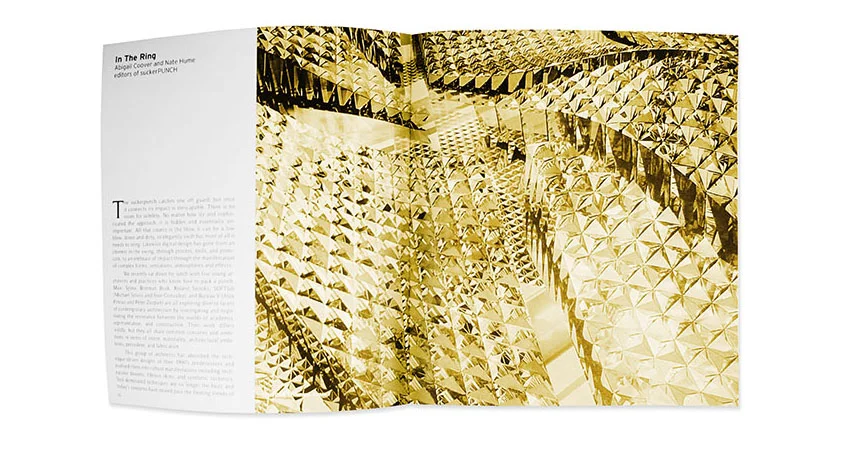
SuckerPUNCH editors Abigail Coover and Nathan Hume interviewed Peter Zuspan and I for an article entitled In the Ring for Pratt’s spring issue of TARP. The spread features our drawing Everything Ornament.

tags: TARP
categories: Archive, Press
Wednesday 05.05.10
Posted by Alexander Pincus
 

Centerfold

Bureau V in Pin Up Magazine

We are featured in issue 7 of Pin-Up Magazine, twice. The first article is about young architects in New York and the second is a story about our large scale drawings, centerfold included.

tags: Pin-Up
categories: Press, Archive
Friday 12.04.09
Posted by Alexander Pincus
 

Slow And Steady Wins The Race: Department Store Installation at Saatchi & Saatchi

Via PAPER, written by Kat Clements:

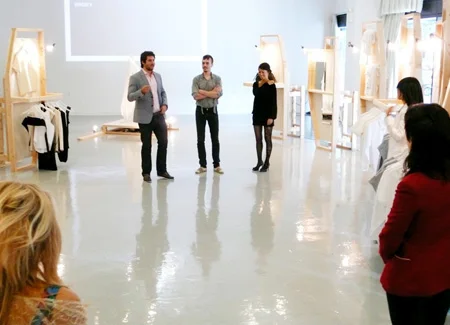
What better way to ease into Fashion Week (I spent the majority of it traipsing around glorious desert dunes at one haute hippy New Mexican wedding) than with Mary Ping and her collaborators at Art/Architecture collective Bureau V. Their project, which debuted at the Saatchi & Saatchi Gallery on Monday, deconstructs our perception of the Department Store, reconstructs the concept of fashion presentations and features a flowy and fabulous addition to the growing collection of offbeat classics by Ping's label Slow and Steady Wins the Race: a $100 wedding dress.
Après-lecture yesterday, in which the architects and designer explored and explained their inspiration for the refreshingly cerebral retail re-creation (Japanese shopping centers, suburban layout à la Levittown, and the pervasion of purchases in our public and private lives) I had a chance to ogle both SSWTR's new perfumes as well as items from all previous collections. Newly found favorites include an amazing white poncho hoodie, and a zippered cummerbund which doubles as a fanny pack! Old favorites remain the four-sided Birkin which I reported on from Paris last season, and a pair of cashmere leggings that continue to haunt me.
The presentation wraps today, so hustle down to Saatchi & Saatchi and experience the pseudo-shop in all of its Slow and Steady glory.
Slow and Steady Wins the Race
The Department Store
Saatchi & Saatchi
375 Hudson St.
September 9-12
11 a.m.-8 p.m.
tags: PAPER
categories: Press, Archive
Friday 09.12.08
Posted by Alexander Pincus
 

Atlantic Yachting

Atlantic Yachting on Coolhunting

Via Cool Hunting, written by Kyle Small:

Last week Atlantic Yachting generously invited us out for an unforgettable four hour sail around Manhattan. Accompanied by Captain Miles and Alexander Pincus—both extremely friendly and knowledgeable about Manhattan and the water that surrounds it—the sail started on Manhattan's Upper West side as we traveled down the Hudson, breathtakingly close to Lady Liberty, past a few of Olafur Eliasson's waterfall installations and found ourselves parked front and center for a fireworks show. 

We brought, food, drink and tunes for a little private sail that proved to be surprising, exciting, but most of all, refreshing—no pun intended. We tend to forget that we are surrounded by water being in the office sometimes, but getting out offers a new look at the city and skyline you can't get from any of the boroughs or bridges.

If you are thinking of getting offshore for a moment, now is the perfect time. It's summer, it's hot and these sails present a breezy and relaxing alternative to sitting in an air-conditioned building all day (it's several degrees cooler out on the water). And, believe it or not, the Hudson is at its least polluted state right now as currents pull in water from the Atlantic.

Another reason to go now are Eliasson's waterfall installations (also reminders of NYC's ignored geography) which will only be up until 13 October 2008. For those of you that don't know, in collaboration with the Public Art Fund, Eliasson built four man-made waterfalls around New York City. You can see them from various points around the city, but getting up close on the water is simply awesome. 

If that's not enough, every so often in the summer, the city puts on a fireworks show that looks absolutely spectacular from the river. We were fortunate enough to be surprised by one of these showings.

While such an experience will cost you, the friendly people at AYA are offering Cool Hunting readers a discount. Just use the super secret password "Cool Hunting" to get 10% off any service provided by the Atlantic Yachting Association or $100 off the Waterfall charter, which can range from $799 to $899 (depending on when you schedule, weekend or during the week respectively). Undoubtedly popular for engagements and a no-brainer for team building and parties, more info is available at AYA. They also offer sailing classes for both adults and kids along with a summer camp. We highly recommend you check it out, I for one can't wait to get back out there.

tags: Cool Hunting
categories: Press, Archive
Friday 07.25.08
Posted by Alexander Pincus
 

Under God: Interview with Mark C. Taylor

Originally published in the Washington Post’s series Under God 

This morning I was lucky enough to spend some time with Mark C. Taylor, Chair of the Department of Religion at Columbia University. I remember having some questions as I stepped into his office, maybe something about Obama or China, but those quickly evaporated. Taylor is one of those wild and brilliant thinkers whose conversations effortlessly cover time and space and everything in between. And once he gets going, it’s hard to keep up and impossible to stop him. The following is a little morsel of the awesome urgency he brought to religion, just enough to whet the appetite.

ME: How did religion get to be where it is today politically? It’s so prevalent in one sense, but it doesn’t seem any deeper than the word itself.

MT: As somebody who’s spent his life reading and thinking about all this stuff, it’s interesting that you have religion back as such a preoccupation in the minds of everybody and yet the understandings of religion are simplistic.

Read more

tags: The Washington Post
categories: Press, Archive, Vintage
Thursday 04.24.08
Posted by Alexander Pincus
 

Under God: Interview with Peter Eisenman

Originally published in the Washington Post’s series Under God

I went to speak with Eisenman last week mostly because I wanted to hear from one of the brilliant architects of our time. But I also wanted to learn if and how he felt architecture could negotiate competing political, religious, and historical forces in a way that enriches our world rather than dividing us. Eisenman wrestled one of the great works of contemporary architecture from the Holocaust, so I assumed that perhaps he had ideas on how to transcend our current cultural and political dramas.

ME: How do you approach the Holocaust as something that can be in any way represented, or is that even something you were after? How do you tackle such a loaded topic via architecture?

PE: Well, it’s not an easy question because I had to tackle it architecturally. I think most attempts at architecture have not been, for me, successful. They tend to be nostalgic for this awful event. You cannot memorialize this action. And so the field of silence, basically, doesn’t say anything. It has no direction, it has no meaning, it has no, no nothing, it’s just a field of pillars that stands mute in the Berlin context.

I think when one considers the Holocaust, as far as I’m concerned, silence is more appropriate than speaking. And when architecture tries to speak it becomes mock-ish, sentimental, and banal.

Everybody says, well, what does this mean? It doesn’t mean anything; it is. And it is there to experience its being, and being of being there. But basically that is it.

Read more

tags: The Washington Post
categories: Archive, Press, Vintage
Monday 04.21.08
Posted by Alexander Pincus
 

Strata Tower

Taschen has just published AE Architecture in the Emirates  featuring the Strata Tower, a project I led the design for while working at Asymptote Architecture. The survey covers built work as well as projects under development and includes some phenomenal as well as phenomenally terrible projects. Also of note, my business partner (and friend) Stella Lee’s design for the Guggenheim Pavilions on Saddiyat Island are also included.

PROJECT CREDIT »
Asymptote Architecture: Hani Rashid and Lise Anne Couture

tags: Taschen | Architecture in the Emirates
categories: Archive, Press, Vintage
Wednesday 02.27.08
Posted by Alexander Pincus
 

Banff Session 2006: New Modes of Practice?

Via Canadian Architect, written by Ian Chodikoff:

This Year's Banff Session Allowed Practitioners From North America and Europe to Define the Methodology of Their Firms. the Issue of Landscape, Research, Sustainability and Rhetoric Were the Primary Issues That Were Both Defined and Defended.
Generally speaking, the 50th anniversary of the Banff Session was a huge success. And although most everyone was appreciative of the opportunity to spend a few days in Banff, some discussion is warranted on the modes of practice that were presented during the session. Beyond the wine and wild roses, one could not help but be disappointed with some of the approaches to practice being presented over the course of the event. While much of the work was challenging and inspirational, there was a considerable amount of empty rhetoric, overwrought pursuits of whimsical formal gestures and outdated diatribes on sustainability. Nonetheless, considerable attention was paid to new methods of approaching and discovering design questions relating to the landscape as well as the search for delight and invention within the urban sphere.
Former editor of Progressive Architecture and current Dean of the School of Architecture at the University of Minnesota, Thomas Fisher deftly and politely moderated several panel discussions involving, among other presenters: James Cutler of Cutler Anderson from Bainbridge Island, Washington; Marlon Blackwell from Fayetteville, Arkansas; PLANT Architect Inc. from Toronto; Thomas Heatherwick from London, England; and Alex Pincus, a stand-in for his employer Hani Rashid of Asymptote in New York. Fisher’s skills as a moderator are exemplary, and he set an agreeable tone for the 26th Banff Session. However, many questions remain which should be discussed so that Canadian architects may clearly understand the difference between empty formalism and the pursuit of invention and innovation in an approach to practice.
One notable firm that believes in pursuing critical and thought-provoking work is PLANT Architect from Toronto. Led by Lisa Rapoport, along with Christopher Pommer and Mary Tremaine, PLANT presented a design process that seeks to describe a new paradigm of landscape architecture and design that eschews the temptation to label their work as simply “landscape urbanism,” “hybridized design” and “multidisciplinary platforms of practice”–catchy phraseology that can mean just about anything. Comprised of both architects and landscape architects, PLANT’s approach to design was summarized through a series of very clear questions. What is it? What does it look like? What are all the pieces? How does it all go together? How is it being built? Being able to analyze the important elements on the site and appreciating their potential involves three important steps: observation, documentation and synthesis. The projects that Rapoport presented, spanning from the well-known Sweet Farm to studies for Meadowlands, New Jersey, all examine the importance of site in terms of physical, historical, spatial and cultural paradigms.
Beginning with their studies for the Meadowlands in New Jersey, PLANT was asked to develop a conceptual master plan for a 20,000-acre area across the Hudson River from Manhattan known as the Hackensack Meadows, a site that is crisscrossed by three municipalities and seven towns. The Meadowlands is a place to drive through on the way to New York or to the Ikea in New Jersey–not a place that inspires change and opportunity. Containing early examples of industrial occupation, parts of the site used to be oak forest, while other areas continue to remain difficult marshlands where consecutive attempts by both the Dutch and the US Army Corps of Engineers failed to dominate the landscape and build upon a difficult terrain. Through the development of several kinds of maps to analyze the rivers, bridges and industrial artifacts, PLANT developed conceptual models to see how the various spaces could be developed, and this process could be of significant inspiration to other designers who wish to work on such a large scale.
Another case study presented by PLANT included the Mtis Gardens project of 1999, which provided an exploration into the many aspects of contemporary garden-making. By walking through the site, the designers came across four mature Quaking aspen and decided to use them as an anchor point for their design concept. The synthesis behind their project involved creating a St. Lawrence landscape that allows visitors to discover the site in a state of repose. A chaise longue, domestic gardens, a bench made of stones collected on the shoreline, fabric screening and a large dividing element constructed of wood and loose straw together create a collage that introduces furniture as a physical manifestation of the landscape, and furthers the discussion surrounding the relationship of inhabitation.
But not every practitioner presented fresh insights into contemporary practice. One of the early disappointments during the session was architect James Cutler. Cutler started his practice in 1977 and as Bainbridge Island grew in population, so did the size and nature of the residences, as dot-com millionaires began populating this once idyllic Pacific Northwest enclave. Admitting that it is difficult to remain a steadfast tree-hugger while practicing as an architect, Cutler was determined to hang on to his vision of treading softly on the earth. But as the complexity of his commissions grew, he realized that he was part of the very machine that is the enemy of nature, and managed to come to terms with the fact that he was helping to destroy the very landscape that he set out to protect. When he was given the commission to design a 55,000-square-foot home for Bill Gates, Cutler believed that the project would provide him with a high-profile soapbox from which to espouse the ethics of designing sustainable architecture. On a somewhat positive note, the amount of old-growth timber required to construct the house necessitated the initiation of a sawmill designed specifically for the ongoing reclamation of old timber in the Pacific Northwest. Raising the issue of environmental sustainability for such a large home is not without its ethical dilemmas.
Although it is possible to appreciate other houses designed by Cutler, such at the Paulk Residence in Seabeck, Washington (1994) or the Long Residence on Orcas Island (2003), these projects are largely conventional homes befitting a special cadre of American elites who enjoy employing vast amounts of natural material in order to create lavish woodsy enclaves in old-growth forests and other environmentally sensitive areas. Cutler’s drawings are beautiful, often produced on vellum and shown with an old-fashioned slide projector, but nowhere do we see any advanced engineering that models energy-efficiency strategies. The projects merely exude that feel-good effect of using lots of wood. Cutler’s work may have been convincing to a professional audience 10 to 15 years ago, but in today’s world, these environmental mantras no longer seem relevant.
The work of Marlon Blackwell was also highly reflective of a desire to engage the dynamics of the region in which he works. The true value of Blackwell’s architecture is that it is born out of a goal of enriching the experience of the everyday. Blackwell’s approach is both fresh and dignified in that it seeks to engage the client in the process of making successful architecture that is tactile and responsive. Ranging from office buildings to single-family residences, Blackwell’s work empowers a local spirit and avoids any pretense of an architectural style. An excellent storyteller and a plain-spoken Southerner, he makes simple buildings elegant–an approach to practice that is both very straightforward yet difficult to emulate.
From an interest in the peculiarity of place, we turn to an architectural process that revels in producing facile and nearly unbuildable forms applied through socially dubious methods. In a delightfully arrogant and well-spoken manner, Alex Pincus was a credible, if not refreshing representative for Hani Rashid from the New York office of Asymptote. Armed with a recently acquired Master of Architecture degree from the paperless architecture school at Columbia–not to mention some professional initi
ation of obscure parlance from his former employer Peter Eisenman–Pincus was on message espousing Asymptote’s party line. Working at various scales, Asymptote produces investigations that range from products to skyscrapers, as well as attempting to engage in urban design. Somehow all the scales seem to share a common theme that is richly rhetorical while fetishizing the aspects of empty formalism.
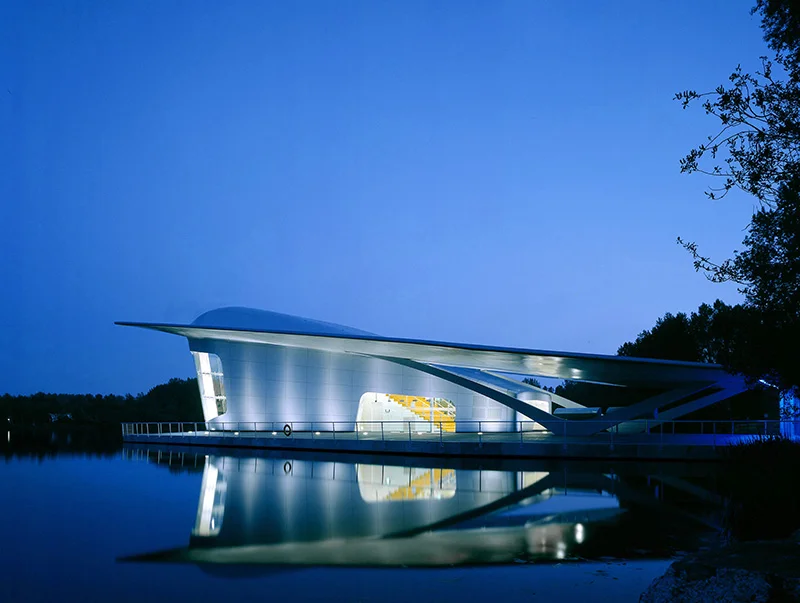
In 2002, Asymptote completed their Hydra Pier near Haarlemmeer, Holland which is their most successful built work. Containing very little program, the project was ostensibly intended to be an iconic building for a flower festival. Situated on reclaimed land near the Schiphol airport, the design process began with looking at the history of Holland when much of its land was under water 150 years ago. Therefore, Asymptote conducted a variety of formal studies looking at hydrodynamics and aircraft design. The fluid and undefined roof plane acknowledges the planar and artificial Dutch landscape while a triptych of curved glass wraps itself around the building opening to the landscape beyond. Pincus speaks of an ill-conceived irony that attempts to frame a landscape through the pavilion’s windows–ascribed to a Dutch landscape painting that is impossible to engage. This hint of irony is neither particularly interesting, nor effective. Framing a landscape through a window where one cannot directly engage the site is no more ironic than stating that a goldfish who swims in a fishbowl cannot engage the environment of the room in which the fishbowl is located.
And as far as operating within a fishbowl, it is puzzling how Asymptote managed to secure a commission to provide a master plan for Georgetown, an old historic colonial town located in Penang, Malaysia. The entire area has around 400,000 inhabitants, half of which occupy an historic centre comprised of Chinese shophouses and a sensitive urban fabric. If one were to actually visit Georgetown, one would be surprised to hear how Asymptote intends to develop a master plan that sets out to negate the town’s post-colonial expansion through the concept of “rails as building envelopes emanating from the hillside as fingers into the city.” With the intention to develop residences, offices, cultural and institutional buildings set against a park and road system, there appears to be no strategic planning behind the intended implementation of hotels, condos, a philharmonic hall, schools, sports arenas, public greens and medical facilities. Beyond naming just about every building type imaginable, Asymptote intends to develop indiscrete buildings that “conform to a three-dimensional blanketing of the site producing an undulation throughout the site and creating an envelope strategy for development.” Aren’t all buildings three-dimensional? In Asymptote’s fascination with form and virtual reality, urban design remains an afterthought that is questionable with respect to the existing social fabric and cultural sensibility of place.
And finally, it is Asymptote’s proposal for the Guadalajara Guggenheim that is the most spectacular example of the firm’s desire to produce an architecture of fantasy. As finalists for the museum competition, the project is not so much an icon, but a hybrid between the “organic and the machine.” The whole building is held together by a parametric structural system whose elements redefine their shape and connections intuitively based on a whimsical digital model sprung from a “megaplinth of culture.” As his night rendering illustrates, the virtual and real come together where Pincus closed by stating, “the spectacle and hybrid of the confluence of digital and real that makes Asymptote the undefined and unclear firm that we are at the moment.”
As a young practitioner with a sense of invention and delight, Thomas Heatherwick was truly a breath of fresh air. Heatherwick founded his firm in 1994, but it was the London Fashion Week installation at the Harvey Nichols department store in 1997 that first brought him attention. The project involved weaving a 200-metre-long structure through the department store’s 12 windows along its faade. Today, Heatherwick Studio comprises an office of 25 people, which include architects, landscape architects, product designers and engineers.
Heatherwick’s manner of speaking about particular design approaches is tinged with a sense of wonder and invention as exemplified by his Rolling Bridge, located on the Paddington Basin in London, perhaps his most published project to date. Another magical project is the “B of the Bang” sculpture completed in Manchester in 2004. At 56 metres in height, it is the UK’s tallest structure. Next to the stadium built for the 2002 Commonwealth Games, the sculpture forms a gateway to the stadium, and is constructed from 180 tapered steel spikes connected at a central point 22 metres above the ground. The structure is supported by five of the spikes that extend more than 20 metres below ground.
On an urban design level, Heatherwick’s scheme for Hong Kong’s Wan Chai district provides an elegant solution for a diverse range of recreational activities. It consists of three significant elements: a series of elevated basketball courts, a hard edge containing night markets and opportunities for sports activities, and finally a reconfigured soccer field that is lowered by 1.6 metres below grade and designed with stepped seating around the perimeter.
Working at a variety of scales–from designing handbags to urban design schemes–one of Heatherwick Studio’s interests lies in product and industrial design research. This has yielded projects like the 30-metre-tall glass bead structure for the Wellcome Trust in London, or the crinkled stainless steel modular panels made rigid with the spraying of CFC-free insulating foam on the back. The panels are to be used on Heatherwick’s Aberystwyth Business Units in Wales, a commission which was secured through a competition to design 20 business units and accompanying multipurpose space for Wales’ largest arts centre. Construction is due to begin in the summer of 2006.
In a very poignant manner, the Banff Session closed with Afghan-American artist Lida Abdul delivering a thought-provoking presentation relating her interpretations of life near Kabul and in Los Angeles. Abdul provided a glimpse of some of the issues that our profession will increasingly find itself addressing in the years to come, notably how to contend with populations living in a global diaspora as well as the responsibility of Western culture and Western cities to connect with what is happening beyond our borders. Her work included videos of her carrying around an idealized vision of inhabitation–a little girl’s dollhouse–throughout the neighbourhoods of Los Angeles. Her main body of work focused on the destruction of houses and villages in Afghanistan and how this destruction had inspired her to seek some means of healing by covering ruins of homes in white paint. The paint represents hope, memorialization and healing. Architects could do well by beginning to understand how we can design through modest means and spiritual depth for a world that is placing increasingly greater demands on the design community to respond to the complexities of our global cultures. Although based in a theoretical context, Abdul is a critically engaged artist who has lived as an Afghan refugee and continues to be in contact with many other Afghan refugees who consider “architecture as a place of hiding, as refuge, as target.” Abdul remarked to me in conversation that she just wanted to give a different perspective on what is going on in today’s global reality, and to perhaps inspire some architects to think of these informal and weak places as well as the many fragile socio-political situations that our world must face.
As Fisher articulated in his desire to bring together the many presenters over the course of the three-day conference, the issue of landscape was a common thread. Blackwell and Cutler exemplified a cultural landscape while PLANT emphasized the natural landscape. Practitioners like Pincus reside in the virtual landscape, while Heatherwick believes in innovation and discovery largely in the urban landscape. At one point, Fisher asked Pincus to defend rather than define his position on buildings that do not consider a sense of place. Pincus merely responded that, “place is a completely constructed concept and the world as we see it is constructed by our own minds. Architecture is by its very nature, alien environments.” Thankfully, most architects would disagree. As the 2006 Banff Session indicated, our world is a very dynamic place that, according to Heatherwick, is full of “particularities.” We should all be so lucky to design in a world full of diverse opportuities and futures.


tags: Canadian Architect
categories: Vintage, Press, Archive
Tuesday 08.15.06
Posted by Alexander Pincus
 

Arrests at GOP Convention Are Criticized

Via The Washington Post, written by By Michael Powell and Michelle Garcia

NEW YORK -- One late August evening, Alexander Pincus pedaled his bicycle to the Second Avenue Deli to buy matzo ball soup, a pastrami-on-rye and potato latkes for his sweetheart, who was sick with a cold.

He would not return for 28 hours. As Pincus and a friend left the deli, they inadvertently walked into a police blockade and sweep of bicycle-riding protesters two days before the Republican National Convention began. "I asked an officer how I could get home," Pincus recalled. "He said, 'Follow me,' and we went a few feet and cops grabbed us. They handcuffed us and made us kneel for an hour."

Police carted Pincus to a holding cell topped with razor wire and held him for 25 hours without access to a lawyer. The floor was a soup of oil and soot, he said, and the cell had so few portable toilets that some people relieved themselves in the corner. Pincus said a shoulder was dislocated as police pulled back his arms to handcuff him. "Cops kept saying to us, 'This is what you get for protesting,' " said Pincus, whose account of his arrest is supported in part by deli workers and a time-stamped food receipt. 

Pincus was one of 1,821 people arrested in police sweeps before and during the Republican convention, the largest number of arrests associated with any American major-party convention. At the Democratic convention in Chicago in 1968, which unlike New York's was marked by widespread police brutality, cops made fewer than 700 arrests.

In the days after the convention, Mayor Michael R. Bloomberg and Police Commissioner Raymond Kelly stated that "every NYPD officer did a great job." But interviews with state court officials, City Council representatives, prosecutors, protesters and civil libertarians -- and a review of videos of demonstrations -- point to many problems with the police performance. Officers often sealed off streets with orange netting and used motor scooters and horses to sweep up hundreds of protesters at a time, including many who appear to have broken no laws. In two cases, police commanders appeared to allow marches to proceed, only to order many arrests minutes later.

Most of those arrested were held for more than two days without being arraigned, which a state Supreme Court judge ruled was a violation of legal guidelines. Defense attorneys predict a flood of civil lawsuits once protesters have settled the misdemeanor charges lodged against them. 

"The overriding problem during the convention was the indiscriminate arrests . . . of people who did nothing wrong," Donna Lieberman, executive director of the New York Civil Liberties Union, said at a City Council hearing last week. "They were arrested because they were . . . participating in a lawful demonstration." 

Police officials declined to talk about these problems last week, citing a pending court case. But the city's criminal justice coordinator, John Feinblatt, said in an interview that city lawyers tried to weed out the unjustly arrested and that the volume of arrests -- more than 1,100 on one day -- overwhelmed the police department. More broadly, Bloomberg and Kelly defended the vast majority of the arrests as justified and described holding cells as clean and humane.

Bloomberg, in interviews during convention week, said that protesters expected prisons to look like "Club Med." Kelly said police encountered other delays as they tried to find separate cells for a large number of female detainees. 

The first mass arrests came three days before the Aug. 30 to Sept. 2 convention, when police swooped down on Critical Mass, a loosely knit collective of bicyclists who periodically flood city streets and slow traffic. Police usually tolerate the disruption, but that night officers arrested more than 200. Kelly told New York magazine that he wanted to send protesters a message.

The next few days were quiet, and a quarter-million-strong march went forward Aug. 29 without incident. 

But the mood changed Aug. 31, when police made 1,128 arrests. Anarchists had pledged a day of resistance, blocking traffic. Police arrested hundreds, and civil liberties lawyers on the scene described most arrests as lawful.

But farther downtown on the same day, the War Resisters League, a decades-old pacifist group, was readying a peaceful march from Ground Zero to Madison Square Garden, where it intended to conduct a civil disobedience "die in." 

A video provided by the New York Civil Liberties Union shows police commanders laying out the ground rules: As long as protesters did not block traffic, they would not get arrested during the walk north. (No permit is required for a march on a sidewalk as long as protesters leave space for other pedestrians to pass.) Within a block or two, however, the video shows marchers lined up on the sidewalk, far from an intersection, as a police officer announces on a bullhorn: "You're under arrest."

"They came with batons, bicycles, they came with netting," said the Rev. G. Simon Harak, a Jesuit priest. "The kind of forces you expect to be turned on terrorists was unleashed on us."

Police arrested 200 people, saying they had blocked the sidewalk.

About the same time Tuesday, several other groups of protesters started walking two abreast from Union Square, the city's historic protest soapbox, to Madison Square Garden. However, several demonstrators say -- and photographs show -- that police soon stopped them, asked them to raise their hands and arrested them. 

Throughout the week, police also picked up dozens of people who appeared to have nothing to do with demonstrations, the New York Civil Liberties Union said. Among those swept up by police were several newspaper reporters, two women shopping at the Gap, a feeder company executive out for dinner with a friend, and Wendy Stefanelli, a costume designer with the TV show "Sex and the City," who was walking to get a drink with a friend. 

She saw a police officer pushing a demonstrator against a wall and asked him to lay off. Police flooded the street, and she was arrested. "I don't know how this could happen," Stefanelli, 35, told the City Council last week. "I was coming from work."

Bloomberg has acknowledged that police may have arrested some innocent bystanders, but he suggested that it was partly their fault.

"If you go to where people are protesting and don't want to be part of the protest, you're always going to run the risk that maybe you'll get tied up with it," he said on a weekly radio show on WABC. 

Police hauled those arrested to newly built holding cells in a former bus depot on the Hudson River. In interviews, two dozen protesters from six states described floors covered in oil and officers who denied access to family and lawyers.

During this time, Deputy Police Commissioner Paul J. Browne twice stated to The Washington Post that most protesters had been released after six or seven hours. Only on Thursday, the last day of the convention, did he acknowledge the much longer delays.

Last Friday, Feinblatt, the city's criminal justice coordinator, attributed the problems to a glut of arrests. Other city officials have spoken of state delays in processing fingerprints.

But senior police officials had said for months that they anticipated 1,000 arrests a day during the convention. Citing such warnings, state court officials, prosecutors and Legal Aid lawyers doubled staffing and opened extra courtrooms during convention week. 

"What happened for several days is that we had resources available and we simply were not getting the bodies produced, the defendants in the courtroom," said David Bookstaver, spokesman for the state office of court administration. 

State officials also released figures showing that they had processed 94 percent of all fingerprints within one hour.

The backlog created a legal crisis for the city. State Supreme Court Judge John Cataldo held officials in contempt of court. "These people," Cataldo said of those arrested, "have already been victims of the process." 

His order resulted in the release of almost 500 people. Tricia Schriefer of Milwaukee had spent two days trying to find her daughter, Claire, 19, a college student who had been arrested Aug. 31. Tricia Schriefer called the police and city offices, only to be told that her daughter was in a legal twilight.

Her daughter was finally released -- without charges -- after Cataldo issued his ruling. "To be held for 50 hours and not be charged . . . it's pretty outrageous," Schriefer said. "It's just counter to everything I had understood about our legal process."

Since the convention ended, protesters have flocked daily into Manhattan Criminal Court, where most of them are accepting misdemeanors and violations -- charges that would typically carry no jail term. The difference between them and someone caught double-parking is that the protesters already had spent two days in jail. 

"Too many New Yorkers were willing to look away," said Norman Siegal, a civil liberties lawyer who is representing Pincus. "We don't lose our rights overnight with a big bang; we lose them incrementally over time."

tags: The Washington Post
categories: Press, Archive, Vintage
Wednesday 09.22.04
Posted by Alexander Pincus
 

Convention Detention

Via The Village Voice, written by Tom Robbins:

Among those Mayor Bloomberg would have "just plead guilty" to arrest charges stemming from the Republican National Convention is Alex Pincus, 28, who spent 27 hours in jail and suffered a dislocated shoulder—all while trying to get chicken soup for his ailing girlfriend.
A graduate student in architecture at Columbia University, Pincus and a friend rode their bikes over to the Second Avenue Deli at the corner of East 10th Street on Friday evening, August 27. In addition to the soup, they bought corned beef and pastrami sandwiches, latkes, and soda. As they were waiting, they saw that the block had filled with bicyclists. These, they later learned, were some of the 5,000 people who had taken part in the Critical Mass ride, pedaling through Manhattan streets shouting anti-Bush slogans. When Pincus and his pal, Isa Wipfli, 29, went to retrieve their own bikes, they found that police had cordoned off the block at both ends. Pincus approached a nearby officer. "I said, 'Hi. We're just here buying dinner. We're not involved. How do we get out of here?' " Pincus said the cop led them down the street and then called two other police officers over, and shouted, "These guys!"
Pincus and Wipfli were immediately seized. "We tried to show them the bags of food and the receipt. We said, 'Look, it's still warm.' They wouldn't listen." One officer took Wipfli's bag and looked inside. "He said, 'Mmm, sandwiches. Looks good,' " said Pincus. What Pincus was more worried about was his chronically ailing shoulder as cops pulled his arms back and placed him in plastic flex-cuffs. "I tried to tell them I can't put it in that position, that it will dislocate. Instead, they pulled my shoulder out of its socket. The pain was tremendous."
Taken to the improvised holding pens at Pier 57 on the West Side, Pincus pleaded with police to at least let him be cuffed in front to ease the pain. "I must've tried to explain to 10 different people until they finally took me to see a nurse. She didn't know what to do, so they took me to St. Vincent's Hospital." On the way there, an apologetic officer told him that under normal circumstances, Pincus would be out of jail already. "He said usually I'd be released within two, three hours. But they had decided to hold people overnight to keep them off the streets so that they'd get the message and not do it again."
On Sunday, Bloomberg insisted that there is not "one shred of evidence" that protesters were kept locked up longer than usual. But he has blocked all efforts to find out. Last week his administration boycotted a hearing of the Committee on Governmental Operations called by Deputy City Council Majority Leader Bill Perkins, who was trying to get some answers about city arrest and detention policies during the protests. Perkins has vowed to issue subpoenas to city officials to compel their appearance, but no subpoena has been issued yet. Perkins said Council Speaker Gifford Miller is personally trying to reach an agreement with the administration to have officials appear before another hearing to be held in early October.
Just how Michael Bloomberg has handled the civil-liberties issues stemming from the convention—his refusal to allow an anti-war rally in Central Park and the controversies surrounding police treatment of protesters—would seem to be a likely issue for those eager to seek his job next year. But the top contenders have been mostly silent on the issue.
Miller, who has raised $3.3 million for a potential citywide race next year, is pushing the mayor to send representatives to the next hearing, aides said. But the council speaker declined to be interviewed about his own views on the subject of how the city handled the convention arrests.
He wasn't the only one ducking the issue. Comptroller William Thompson, another would-be Democratic mayoral contender, also begged off, citing the (largely administrative) role his office plays in overseeing legal claims against the city that will arise from the arrests.
In response to Voice questions, Manhattan borough president C. Virginia Fields, another mayoral wannabe, said she was disappointed in the city's performance. "We all knew, almost a year in advance, that hundreds of thousands of protesters were coming to New York," she said. "We all made the assumption that this is what the police department and city were preparing to address—not violating civil liberties or keeping people locked up for more than 24 hours without being arraigned."
"Detaining people for over 24 hours for the equivalent of a parking ticket is way over the top," former Bronx borough president Freddy Ferrer, a likely candidate in 2005, told the Voice. "The council is appropriately holding hearings, and the administration should appropriately answer questions. [Police commissioner] Ray Kelly is a good guy, but that doesn't give him immunity from answering in public."
Actually, as Perkins and several witnesses at the hearing pointed out, it's not that the mayor and Kelly aren't talking about the convention arrests; they're just picking their spots.
The two men authored a joint New York Post op-ed piece on September 10 hailing their own performance as a success, and insisting that Pier 57—where protesters said they were forced to lie down on oil-coated, rash-producing floors—"was run in a humane fashion and was well-equipped." Delays in processing arrestees had occurred, they wrote, "but not before nearly 1,200 protesters decided to break the law" on August 31 during a day of multiple demonstrations. Because of that upswell, "it shouldn't come as a surprise that waiting time [for release] may exceed the norm."
At the hearing, however, lawyers from the New York Civil Liberties Union produced a videotape of one mass arrest indicating that many of those jailed that day had not actually participated in civil disobedience. The tape showed police officials arresting more than 100 people who were peacefully walking near ground zero, heeding police orders to not block the sidewalk.
Kelly also told New York magazine's Robert Kolker that the Friday night arrests at which Pincus and his friend were picked up were part of a purposeful get-tough strategy. "Kelly admits now that he was sending a message," Kolker wrote. " 'It was clear,' [Kelly] says, 'that if they succeeded on Friday night, you were going to see a lot more of this when the convention kicked in.' "
If that was the direction that top police commanders issued to their troops, then it's little wonder that soup-and-sandwich-buying bystanders like Pincus and Wipfli got swept up in the nets. Last Friday, Pincus, wearing a suit and tie, showed up in Manhattan criminal court, where he pled not guilty to two counts of disorderly conduct and one count of parading without a permit, all violations punishable by up to 15 days in jail.
"I think Bloomberg and Kelly thought there would be a lot of praise for keeping the city quiet," said civil liberties lawyer Norman Siegel, who, along with Earl Ward, represented Pincus. "They'd floated the idea there was going to be all this violence, and they kept saying, 'We're prepared. Citizens can go about their business.' Well, what about this citizen?"
tags: The Village Voice
categories: Press, Archive, Vintage
Tuesday 09.14.04
Posted by Alexander Pincus
 

THE REPUBLICANS: THE CONVENTION IN NEW YORK -- THE POLICE; With Restraint and New Tactics, March Is Kept Orderly

Via The New York Times, written by Michael Slackman and Al Baker:

Plainclothes police officers on stylish Italian motorscooters herded bicycle-riding demonstrators into thick orange nets stretched across intersections. Airborne spy cameras on blimps and helicopters monitored the crowd. Digital video cameras were used to tape arrest scenes and collect evidence for later use in court. A military-inspired sound device was ready to disperse crowds with shouted orders or painful blasts of noise.
After more than a year of planning and training, the New York Police Department oversaw yesterday's giant protest march by combining traditional methods of crowd control -- from undercover officers who infiltrated the crowd to a huge show of force -- with a variety of new techniques that clearly took some of the protesters by surprise.
The combined methods appeared effective at keeping yesterday's marchers where the police wanted them to be, and even protest advocates praised the police for their overall restraint, noting in particular that individual officers did not allow themselves to be provoked by the very few attempts to incite them.
When one protester threw what looked like feces at a row of young police officers on Seventh Avenue outside Madison Square Garden, they stood frozen and did not flinch, even to wipe away what turned out to be pieces of cardboard. When a group of protesters climbed atop some construction scaffolding, officers coaxed them down, then let them leave without arrest.
Continue reading the main story
Advertisement
Continue reading the main story
This was part of the strategy that is beginning to define one of the greatest tests the Police Department has seen in recent years, not only dealing with successive days of protests, but doing so as journalists from all over the world are watching. Officers were drilled on teamwork, trained to respond to a supervisor's orders and never to react to a simple taunt.
When officers were ordered to make arrests, they acted quickly with precision, taking more than 200 people into custody yesterday, though at times over the weekend they moved so quickly that, it appears, they also swept up innocent bystanders who were in the wrong place at the wrong time.
Even some of the Police Department's most persistent critics reluctantly gave the police good marks, though several said most of the credit for good behavior belonged to the demonstrators.
''A quarter of a million people made a commitment to a peaceful legal march,'' said one of yesterday's marchers, Ronald Kuby, the civil rights lawyer from New York who gave his own unofficial estimate of the crowd size. ''They were the ones who kept the peace. They were the ones who were well behaved. So this notion that the police did a good job is true only to the extent that the demonstrators themselves had a powerful commitment to keep this demonstration peaceful and legal.''
The greatest show of force came at the corner of Seventh Avenue and 34th Street, where the march turned east after moving uptown. On one corner more than a dozen officers sat on horseback, while dozens of other uniformed officers lined the streets. Motorcycles, scooters and vans filled the pavement just beyond the border of the protest zone.
A few yards away, at around 3 p.m., a fire broke out when a papier-mâché float made to look like a dragon was set ablaze. The police quickly blocked off the route at 34th Street and Avenue of the Americas and put the flames out with fire extinguishers. Several people were arrested, one of whom was charged with arson.
For all the preparations to deal with the crowd, it appeared that the police forgot at least one essential detail -- water for the officers who were weighed down with body armor and riot helmets. Officers had to rely on their supervisors to run into local convenience stores to buy water.
Still, over and over, as hundreds of thousands of people marched yesterday, up Seventh Avenue, across 34th Street and down Fifth Avenue, the police showed restraint, turning away, for example, when they were mocked for failing to secure a desired raise from the city. At one point, a large group of demonstrators surrounded a patrol car, waving anarchist flags and taunting the two officers inside. The police officers hit their siren, backed up and drove off. A few uniformed officers arrived and ordered the protesters onto the sidewalks, and the group just melted away.
There were red lines, however, and anyone on a bicycle seemed to be on the wrong side of that line. At a large bike protest on Friday, the police showed they were resolved to keep the bikes from blocking traffic, and they did that again yesterday. Bicycle-riding protesters said that the people in civilian clothing (who they assumed to be police) would ride into the pack of cyclists to slow them down. Protesters said the police strategy seemed to be contain, surge and arrest.
One incident involved a group of cyclists a few blocks away from the parade route. Chris Habib, 29, said police scooters sought to move the cyclists off the street by nudging their tires. He said that as the cyclists reached Seventh Avenue traveling west on 37th Street, they slowed, facing a dilemma. Police blocked any turn south and, the bikers believed that turning north on the southbound avenue would result in instant arrest.
Several bystanders said the police arrested people who were not protesting but happened to be in the area when the police swooped down.
At the Second Avenue Deli, Alexander Pincus, 28, and Isa Wipfli, 29, had just picked up a dinner of matzo ball soup, pirogi, pastrami and corned beef for Mr. Pincus's girlfriend when they stepped outside and saw swarms of police officers and bicyclists. Mr. Pincus said he and Mr. Wipfli approached a police officer looking for a way out.
''They took our bikes and handcuffed us,'' Mr. Wipfli said. ''We were like, 'Look at the food. It's still warm.' They wouldn't listen to anything we said.''
tags: The New York Times
categories: Press, Archive, Vintage
Monday 08.30.04
Posted by Alexander Pincus
 
Newer / Older